The Ghosts
of the Alamo
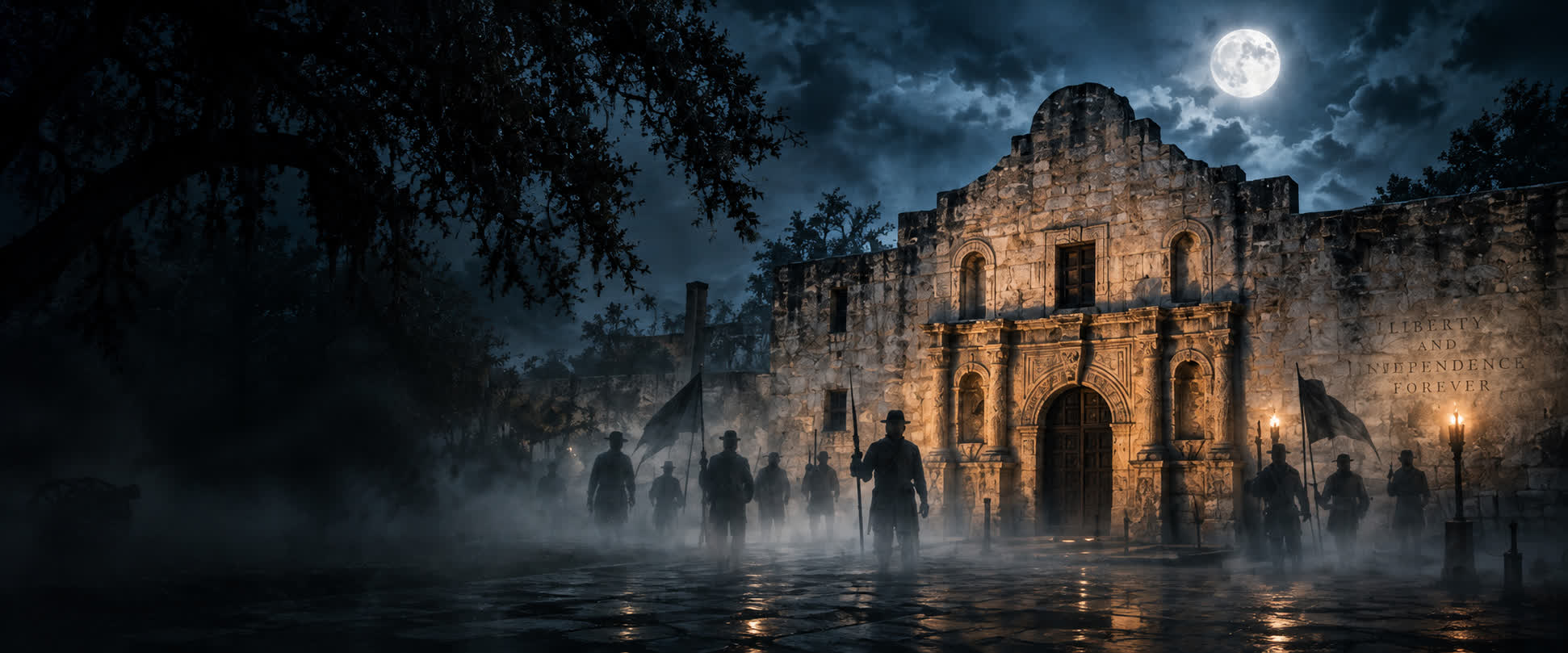
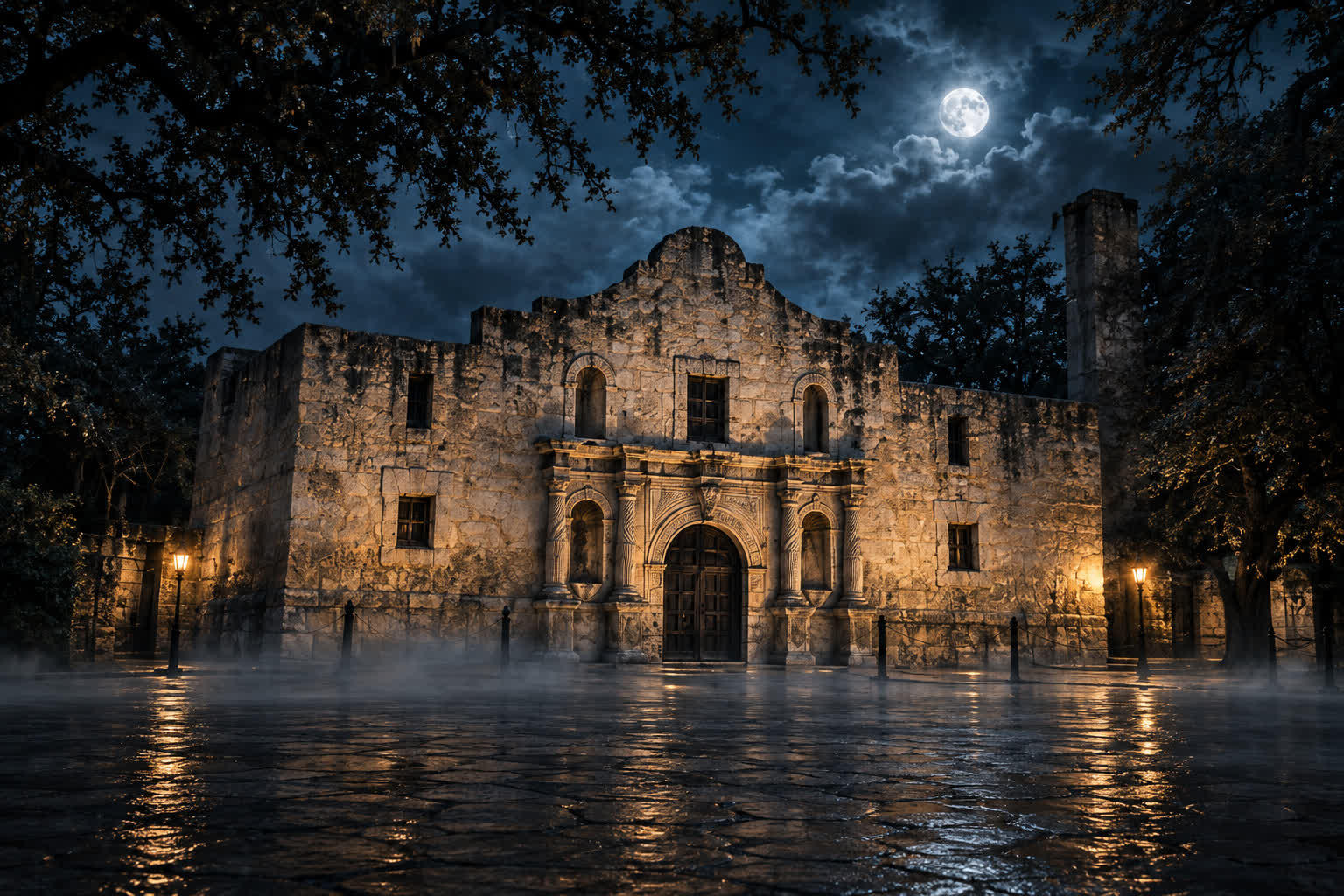
Visitors and staff have long reported shadowy figures wandering the grounds at night. One account even describes an entire phantom army marching from the Alamo.
San Antonio After Dark
The people, places, and peculiar little worlds thriving just beneath the Texas you thought you knew.
Enter the Unknown
Visitors and staff have long reported shadowy figures wandering the grounds at night. One account even describes an entire phantom army marching from the Alamo.
A car rolls across the tracks without a driver. In the dust, small handprints are said to remain.
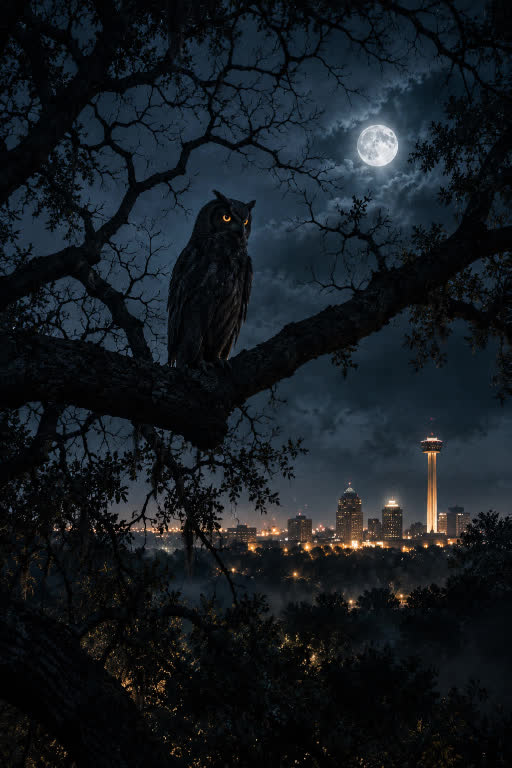
A giant owl. A woman in the dark. A warning passed quietly from one generation to the next.
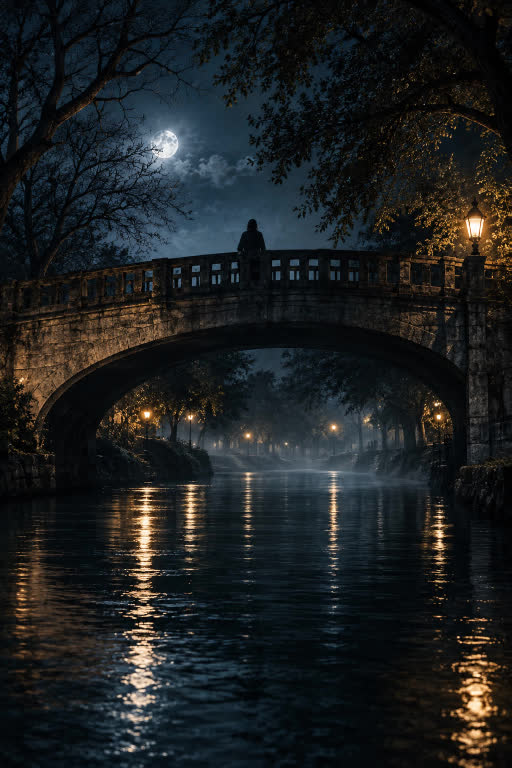
Beyond the city lights, a lonely bridge carries a legend marked by fire and an unsettling cry.
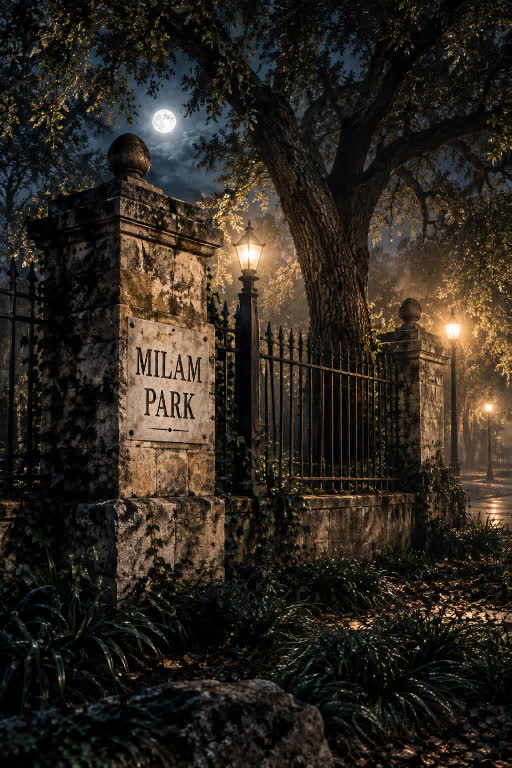
A peaceful city park sits over an old cemetery, where not everyone may have been moved.
Get new features, hidden histories, and peculiar places delivered to your inbox.
The legend actually starts just weeks after the battle itself. When Santa Anna headed toward his eventual defeat at San Jacinto, he sent orders back to San Antonio for the rearguard to burn what remained of the Alamo. The bodies of the fallen Texans had already been reduced to ashes on funeral pyres, so torching the mission itself seemed like a fitting final act.
According to the legend, when soldiers arrived with torches to carry out the order, a spectral figure, sometimes described as a monk-like guardian, rose up amid the ashes and drove them off, refusing to let the site be destroyed. Whether or not you buy the ghost story, historically the Alamo was never actually burned down, which is part of why the tale has stuck around for nearly two centuries.
During the 1836 siege, roughly 1,600 Mexican soldiers and 200 Texans were killed, with casualties buried in mass graves, thrown into the San Antonio River, or burned in mounds. On top of that, the ground beneath Alamo Plaza had already been used as a cemetery between 1724 and 1793, with an estimated 1,000 people buried there before the battle even happened. Construction crews still turn up skulls and bones when digging in the area today. That is a lot of layered death in one small footprint, which locals point to as the reason the hauntings never seem to stop, no matter what the site is used for.
The legend really took hold in the public imagination when the Alamo was repurposed as a police station and jail. Between 1894 and 1897, several articles in the San Antonio Express-News described ghostly sentries pacing along the police station's roof, plus shadows and moaning sounds heard by staff and prisoners. The activity was so unsettling that guards began refusing to patrol the building after dark.
The legend has since split into several recurring “characters”:
The through-line in all of it: whether the Alamo was a mission, a fort, a jail, or today's museum, the story locals tell is the same. The spirits of the defenders never left, and still stand guard over the ground where they died.
This is San Antonio's most tested legend, centered on the railroad crossing where Shane Road meets Villamain Road. As the story goes, sometime in the 1930s a school bus full of children stalled on the tracks and was struck by a train, killing everyone aboard. Ever since, people say that if you put your car in neutral on the crossing, the ghosts of those children will push it to safety. Sprinkle baby powder on your bumper first and you will supposedly find tiny handprints afterward.
The legend has largely been debunked. Investigative reporting found no record of any such accident in San Antonio. A similar disaster did happen, but in Salt Lake City in 1938, and researchers believe heavy news coverage of that crash migrated into local Texas folklore over time.
The “pushing” sensation is an optical illusion: the road looks uphill but is actually on a slight downhill grade, so a car in neutral naturally rolls forward. Even the nearby streets, often cited as being named after the victims, were actually named after a real estate developer's grandchildren. Despite the debunking, the SyFy show Fact or Faked tested the site and confirmed the downhill illusion themselves. In 2018, Union Pacific altered the track elevation for infrastructure reasons, which effectively ended the phenomenon for good.
Unlike the other legends, this one is not unique to San Antonio. It is a much older piece of Mexican and Tejano folklore found throughout South Texas and the borderlands, but it is deeply embedded in San Antonio's own scary-story tradition.
La Lechuza is a shapeshifting witch who takes the form of a massive owl, sometimes four to seven feet tall with a wingspan wide enough to blot out the stars, but with the face of an old woman. In most versions, she was a woman wronged or persecuted by her community in life, who returns after death to seek revenge.
Her signature trick is mimicking the cry of a baby to lure victims outside at night, at which point she attacks. The rules for surviving an encounter are specific: never respond if she whistles at you, and never shoot at her, since the lore holds that the harm will boomerang back onto you instead. Parents in the region have long used her as a folk deterrent to keep kids from wandering outside after dark.
This one centers on a bridge over Elm Creek near Applewhite Road on San Antonio's south side. Nobody agrees on when it originated, with estimates ranging from the mid-1800s to the 1950s, and the versions of the story contradict each other wildly.
In the most common version, a farmer set fire to his own home and murdered his children, leaving his wife horribly disfigured. Her hands melted into hoof-like stumps and her burned face took on an elongated, donkey-like shape. Grieving and enraged, she is said to haunt the creek and bridge ever since.
A second version flips the villain: a cruel stranger beats the family's donkey, gets run off, then returns at night to burn the house down and kill the father and children. The mother escapes the fire already disfigured, chases off the arsonist, and disappears into the river, her body never recovered.
Interestingly, some folklorists read the tale less as a ghost story and more as a reflection of how disabled or “non-normative” women were historically treated and mythologized in the region. Regardless of origin, generations of teenagers have treated a nighttime trip to Donkey Lady Bridge as a rite of passage.
The shortest and least elaborate of the bunch, but persistent. The park sits on the site of an 18th-century cemetery, and while headstones were removed when the land became a public park, the belief is that many of the bodies themselves were never actually relocated.
Locals say the displaced spirits remain restless beneath the walkways and lawns where people now stroll, picnic, and gather for events, making it one of downtown San Antonio's quieter but longer-running ghost stories.
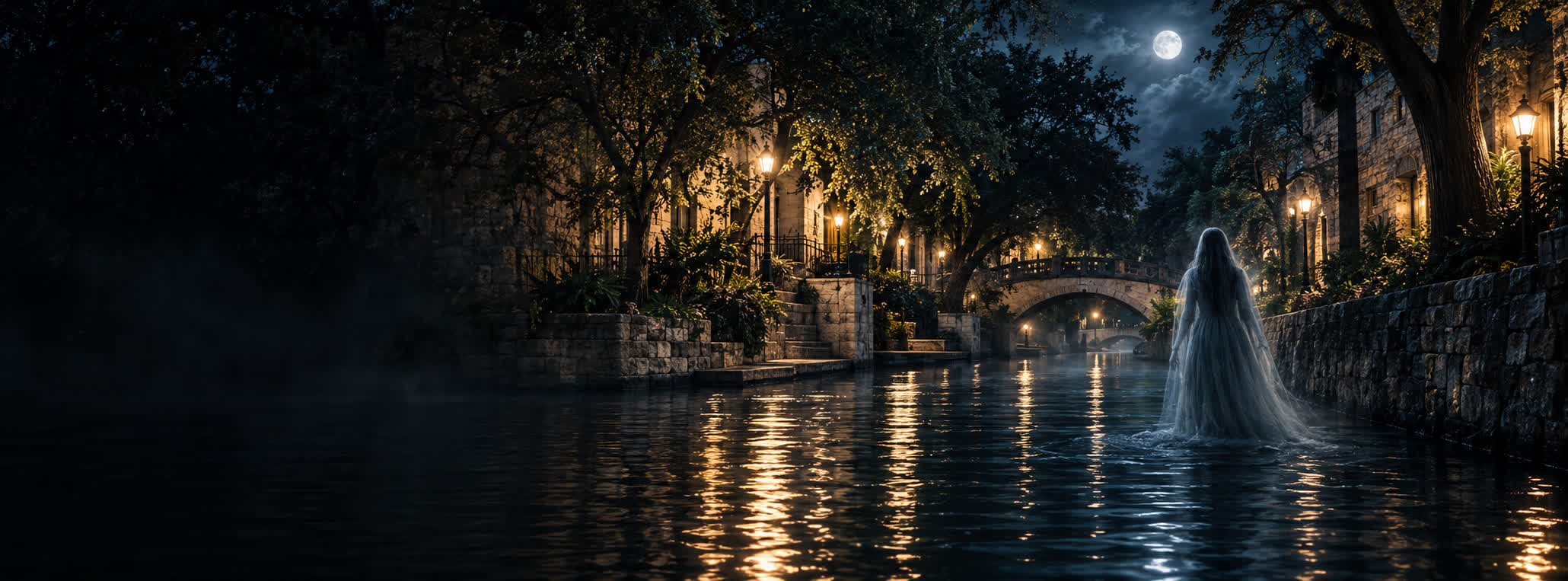
This is the oldest and most widespread of all these legends, likely predating the others by centuries. Some folklorists trace roots back to Aztec mythology, possibly linked to the goddess Cihuacóatl, who was said to wail in grief. It arrived in Texas with early Mexican and Spanish settlers and took hold along waterways throughout the borderlands, including the San Antonio River.
The core story, told in dozens of regional variations, follows a beautiful woman, often named Maria, who falls in love with a wealthy man. They marry and have children, but he eventually leaves her, sometimes for a younger woman, sometimes simply abandoning the family. In her grief and desperation to win him back, she drowns her own children in the river. The instant it is done, the horror of what she has done hits her, and she drowns herself as well.
As punishment, she is cursed to wander the earth for eternity, searching for her lost children and weeping “Ay, mis hijos” (“Oh, my children”) along every riverbank she haunts. In some tellings she does not just search; she actively tries to lure or steal other children to replace her own.
One San Antonio-specific version, passed down locally, places her origin in the city itself in the early 1800s, as a young widow who remarries into wealth and drowns her children out of jealousy over her new suitor.
The legend's staying power in San Antonio owes a lot to how useful it is as a parenting tool. Generations of mothers in the region have invoked her as a bogeyman to keep kids away from the water and out too late at night: “La Llorona will get you.” There is even a place named Woman Hollering Creek on the city's far east side toward Seguin, a literal landmark named for the legend.
Unlike the Ghost Tracks, this one has never really been “debunked,” mostly because it was never treated as a single, checkable event. It functions more like a moral fable than an urban legend tied to one incident, which is part of why it has survived, virtually unchanged in its core, for so long.

Distinctly Texan Magazine
An Original Publication by
High Card Studios
© 2026 Distinctly Texan Magazine. All rights reserved.