Jacob Brodbeck was born in 1821 in the German duchy of Württemberg, immigrated to Texas in 1846, and spent the next several decades as a schoolteacher, county surveyor, and eventually county commissioner in the German Hill Country around Fredericksburg and Gillespie County. But his real obsession one he pursued for over 20 years on the side was flight. As he put it himself in a public notice printed in the Galveston Tri-Weekly News on August 7, 1865: "For more than 20 years, I have labored to construct a machine which should enable man to use, like a bird," the atmospheric region as the medium of his travels.
That notice was actually a fundraising pitch Brodbeck was selling shares in his invention to investors, promising them a cut of the profits once he perfected it. By 1863, he'd built a spring-powered model airship complete with a rudder, wings, and a propeller, and predicted it could eventually reach speeds of 30 to 100 miles per hour.
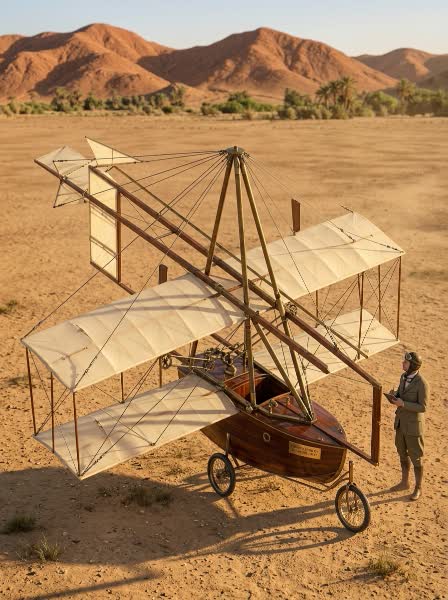
Then, on September 20, 1865 by the most commonly repeated account Brodbeck brought a full-size version to a field near Luckenbach, Texas, in front of gathered spectators. The craft had an enclosed compartment for the pilot, a water propeller in case of an emergency landing, a compass, and a barometer. He climbed in, started the spring mechanism, and the airship actually rose about 12 feet into the air and traveled roughly 100 feet before the spring fully unwound and the machine crashed. Brodbeck walked away unhurt; his airship did not survive the landing, reportedly crashing into a chicken coop.
Here's where the story gets genuinely murky, the Texas State Historical Association's own Handbook of Texas openly states that "Brodbeck's aviation achievements remain shrouded in doubt." Some accounts place the flight in San Antonio's San Pedro Park instead of Luckenbach. Others claim it happened in 1868, not 1865. No blueprints, drawings, or verified photographs of the actual flight survive there's only a disputed glass plate negative that "may" show the wreckage, with no confirmation it's genuinely his craft.
What happened afterward is its own small tragedy. His investors, spooked by the crash, refused to fund a second attempt. Brodbeck went on a fundraising tour of the U.S. to try to raise money again, but Reconstruction-era headlines dominated public attention and nobody bit and at some point during the tour, his notes and diagrams for the airship were stolen in Michigan, meaning he lost even the paper record of his own invention. Defeated, he returned to his ranch near Luckenbach, dismantled what remained of the craft, buried it on his property, and lived out the rest of his life there until his death in 1910 six years after the Wright brothers flew at Kitty Hawk and made aviation history official.
Texas hasn't let the story die, disputed or not. In 1967, Governor John Connally formally declared Brodbeck the "Father of American Aviation." There are two separate busts of him one in San Pedro Park, one in Fredericksburg plus an official Texas historical marker in Luckenbach, and even a restaurant named after him and his airship's spring mechanism at DFW Airport.
It's a story that occupies a strange, honest space not a proven fact, not a debunked myth, but a genuinely plausible historical mystery that Texas has chosen to memorialize anyway betting on its own folk hero even without the paperwork to fully back it up.